 Español
 English
 Français
 Deutsch
 Norsk
Norsk Svenska
 Italiano
 Português
 Suomi
Suomi Nederlands
 Dansk
Dansk Polski
 Čeština
 Slovenčina
 Magyar
 Slovenščina
 Български
 Hrvatski
 Österreich
 België
Navelina Oranges
It is the first to be harvested.
Discovered in Riverside, California, in 1910 as a spontaneous mutation of the Washington Navel, it was originally given the name Smith's Early Navel.
In 1933 the University of California sent it to the Valencian Institute of Agrarian Research in Spain, where it was given the name Navelina. Curiously, the variety was not propagated commercially until 1968, the year in which it was handed over to the nurseries, after which it acquired great commercial importance.
Among the orange tree varieties, the Navelina is of the Navel type; the tree is medium-sized, more or less rounded in shape, with large, dark green leaves. The tree is very productive, although with a certain tendency towards alternate bearing.
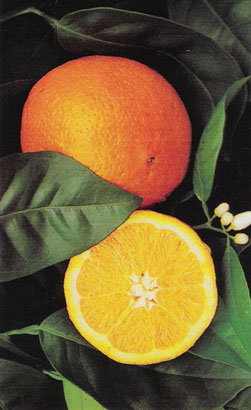
It is the orange tree variety most resistant to cold and to lime. It is usually de-greened to bring the harvest forward. It comes into production quickly, and does so abundantly; it is one of the most cultivated varieties, of great quality for fresh consumption. It is very interesting in all citrus-growing areas, but especially in those where the risk of frost is greater and where, therefore, a very early harvest is of interest.The fruits are large, rounded or slightly oval in shape; it is an orange with no seeds, the flesh is fleshy and has a large amount of juice, the skin is an intense orange colour and the navel is not very prominent.
This variety has been very popular in Spain over the last 30 years, due to its great quality and to the fact that, under those conditions, it allowed the harvest to begin very early and with fruit in perfect condition.